As the US-backed war and genocide waged by Israel against the Palestinian people in Gaza reached its 7th month and a new wave of opposition to it exploded on campuses across the country, another escalation by the US government to counter this resistance came in the form of the Anti-Semitism Awareness (ASA) Act of 2024, passed by the US Congress on April 30, 2024. This new bill is another weapon in the repressive arsenal passed to counter, intimidate, and crush protests and opposition to this US-funded and -armed war by increasing the risks of potential consequences.
This Act, passed overwhelmingly in the House of Representatives, is a step in the direction of enshrining in law a vague definition of antisemitism that encompasses any criticism of Israeli policy and crimes by codifying the definition created by the International Holocaust Remembrance Alliance (IHRA) in Title VI of the Civil Rights Act (CRA) of 1964. The IHRA definition of antisemitism includes the “targeting of the state of Israel, conceived as a Jewish collectivity,” and the Act would allow the federal Department of Education to restrict funding and other resources to campuses perceived as tolerating “antisemitism” based on this definition.
It could additionally require, for instance, the Department of Education to use the IHRA definition when judging antisemitism complaints at universities and colleges or against universities to revoke funding for failing to discipline students, ban events, campus groups or professors who speak out against Israel. If universities fail to restrict statements covered by the definition, they could risk having their federal funds withheld. Even one of the lead drafters behind the IHRA definition of antisemitism, Ken Stern, has consistently opposed the Antisemitism Awareness Act or the use of the broad definition for legislative purposes.
This was passed in the House of Representatives by a large majority (320 – 91) in the midst of a widespread, determined upsurge of student protest, primarily centered around largely nonviolent student encampments at colleges and universities across the country (and across the world). While specific demands varied, they largely called for an end to the genocide and for their universities to divest from companies doing business with Israel or that fund or arm the genocide. This bill was passed precisely to counter, intimidate, and crush these protests and opposition to this US-funded and -armed war by increasing the risks of potential consequences.
As opposition increased and grew more determined, a vague and broad use of allegations of antisemitism was deployed to attack, condemn, and ban students, professors, organizations, media professionals and others who have spoken up even before this definition of antisemitism became law.
According to a report by Palestine Legal, “Reverberations of October 7th,” this has included:
- Suspending, deactivating, or banning the two main opposition groups, Students for Justice in Palestine (SJP) and Jewish Voice for Peace (JVP), as well as other organizations on multiple campuses including all public universities in Florida, Brandeis, George Washington, and Columbia.
- Dozens of professors were suspended or reprimanded for speaking against genocide, criticizing Israel or somehow supporting student protests. (When people rallied and opposed these suspensions some were reinstated.)
- Between October and December 2023, Palestine Legal received hundreds of requests for assistance for discrimination at work for anti-Israel or Pro-Palestine statements including over 100 from people who had lost their jobs.
- Dozens of events featuring Palestinian and anti-Zionist scholars and advocates at universities, libraries, and bookstores were cancelled.
- Activists reported an increase in FBI and other law enforcement visits, often prompted by social media posts about Palestine.
The President – Genocide Joe Biden — has from the beginning issued statements condemning what he is calling antisemitism and hate speech. Multiple university presidents and school principals have been dragged before a series of congressional hearings and berated for not addressing “rising antisemitism,” that included slogans and actions by students that condemned the US/Israeli war and supported Palestinian rights and resistance. Several of them, including the Presidents of Harvard (the first Black woman to hold that position) and U Penn were quickly fired or resigned after appearing before congressional hearings.
The use of the charge of antisemitism against those who criticize or attack Israel is nothing new – internationally and in the US. The Boycott, Divestment, and Sanctions Movement (BDS) has called for actions against companies based in and supporting the Israeli economy or doing business with or supporting the occupation in various ways. Modeled on the successful attempts to boycott the South African Apartheid state and highlight the unjust nature of its Apartheid policies, the BDS movement has been in existence for nearly 20 years. In response to its efficacy, thirty-five states have passed anti-BDS laws, resolutions or executive orders, based on the argument that Israel is the only Jewish state and therefore boycotts against it are antisemitic. Most measures explicitly ban states from doing business with companies that support the BDS movement, while some non-binding resolutions merely condemn the movement.
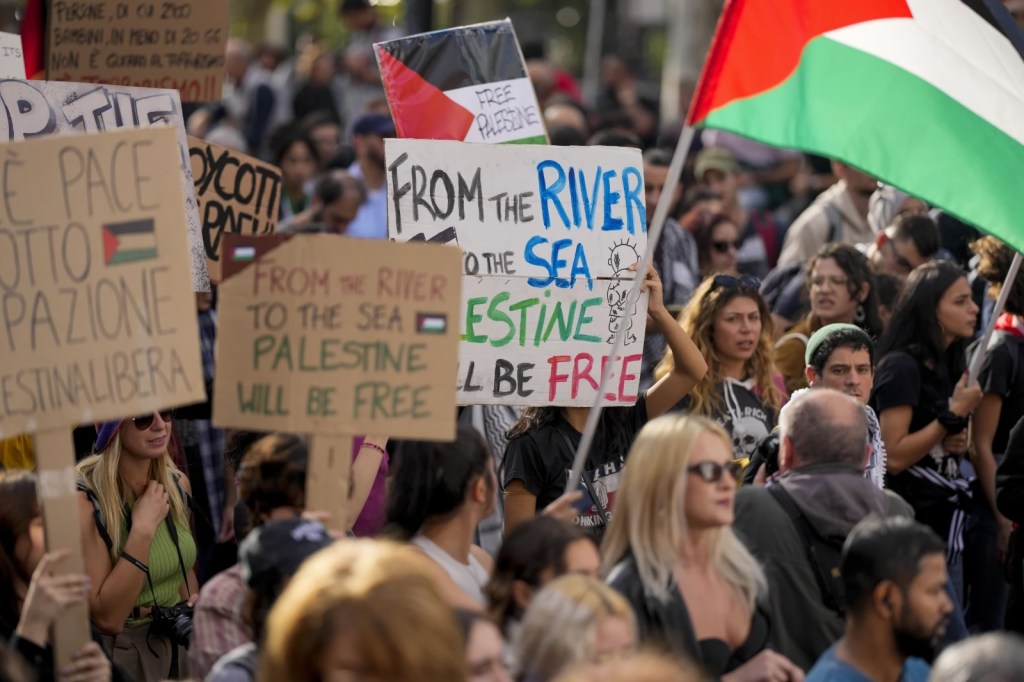
Some of the first protests against the US/Israeli genocide in Gaza were amongst students on college campuses, and some of the first groups suspended or banned were Students for Justice in Palestine (SJP) and Jewish Voices for Peace (JVP) at Columbia University. Suspensions were based on vague accusations of violating campus policies (policies that were specifically being changed in order to restrict and stop the activities of both SJP and JVP) and that demonstrations “included threatening rhetoric and intimidation” that was deemed to be antisemitic based on the use of slogans like “From the River to the Sea – Palestine Will be Free,” a call for the liberation of Palestine and a return of their homeland for them to live in free of occupation. This slogan in particular has been a target for accusations of antisemitism, with some going as far as to label it “genocidal” against Jews.
In Spring 2024, as college protests grew into bold encampments and building take overs, they were attacked by politicians from New York Mayor Adams declaring “I am horrified and disgusted with the antisemitism being spewed… and I have instructed the NYPD to investigate any violation of law,” all the way up to Genocide Joe Biden’s White House statement that “This blatant antisemitism is reprehensible and dangerous.”
Claims of antisemitism with little backing, citing isolated incidents and distorting the views of protesters, against actions that contained a significant contingent of participating Jewish students, paved the way for the brutal, over the top police assaults on largely non-violent and peaceful encampments on campuses across the country.
The current ASA Act has passed in the House of Representatives. It won’t become law unless the Senate passes it. The Act also currently falls within civil and not criminal law, but since antisemitism is also considered a “hate crime” that can be used to enhance or inform criminal prosecutions, there is a more dangerous direction that encoding this in law by the Congress can lead to. While most critics are pointing to the stifling of and attack on free speech represented by the Act, the more ominous element is that it establishes in federal law a definition of antisemitism that can then potentially be used to bring hate crime enhancements or charges against people supporting the struggle of the Palestinian people and/or opposing the genocide being carried out. These charges bring with them prison sentences and lifelong marks on people’s records.
As hundreds of students across the country are facing possible criminal charges as well as academic discipline and suspension, this act becoming law could force universities to come down hard or risk losing important federal funds. This increases the legal penalties for opposing the US-backed genocide in Palestine. It’s a way to both intimidate and deter any protests against Israel, because a conviction could get a hate crime enhancement.
This is a very specific and underhanded way to go after protest and dissent, much like the use of domestic terrorism enhancements against protestors, such as the charges leveled against those who have been arrested for protesting the “Cop City” police training facility in Atlanta. In that case, dozens have had domestic terrorism enhancements added to their arrests, even for minor things such as presence in a park at a concert or handing out flyers that named cops who were part of killing a protester. The potential for possible use of hate crime enhancements can be seen in the example of Jessica Resnicek, who AFTER pleading guilty to property destruction in an action against the Dakota Access Pipeline, had the judge add a domestic terrorism enhancement (it wasn’t part of the charge she pled guilty to) which added years to her sentence. This is in addition to what many are calling “the Palestine Exception,” where unofficially there are increased penalties – both university discipline or criminal penalties – if the supposed crime stemmed from support of Palestine and opposition to Israel.
Unfounded and unproven accusations of antisemitism are a way to deflect attention from the on-going war crimes and genocide being carried out by Israel and the U.S. These are used as intimidation and to suppress opposition. We need to continue to expose these attempts to stifle protest and support ALL those who are being persecuted for it – whether that is firing from a teaching position, school disciplinary charges or criminal charges. If you or someone you know is facing these types of charges reach out to Mass Action Defense and let us know how we can support.
 Mass action defense